
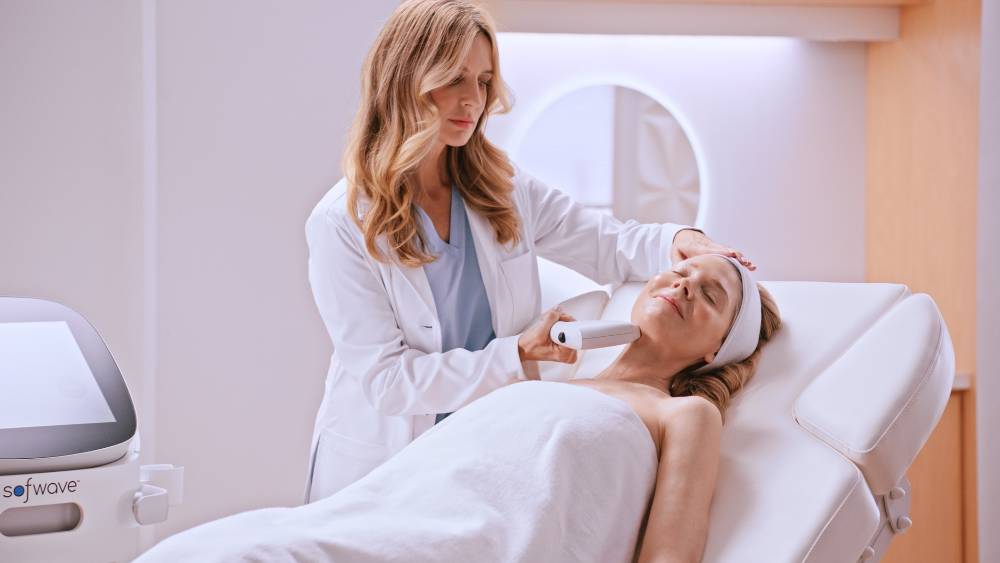
Quick answer: Sofwave and Xerf are both needle-free skin tightening treatments with little or no downtime, but they use different energy. Sofwave uses focused ultrasound at a precise depth in the skin to stimulate new collagen, and is usually done in a single session. Xerf uses dual-frequency radiofrequency that heats the skin and deeper layers more broadly. Both can firm the jawline and lower face. The right choice depends on your skin, your concerns and your budget, which is what a consultation is for.
Xerf has had a lot of attention recently, and several of my clients have asked how it compares with Sofwave, which I offer in Hampstead. I don’t offer Xerf, so I want to be upfront about that. This guide sets out the facts about both, as fairly as I can, so you can make an informed choice.
What is Sofwave?
Sofwave uses a technology called SUPERB™: seven parallel beams of high-frequency ultrasound that heat the middle layer of the skin (the dermis), at a depth of about 1.5mm, while the surface is actively cooled. This controlled heat triggers new collagen and elastin. It is FDA-cleared for lifting the eyebrow, the lax tissue under the chin and the neck, and for improving fine lines and wrinkles.
What is Xerf?
Xerf is a radiofrequency (RF) device made by Cynosure Lutronic and developed in South Korea. It combines two radiofrequency frequencies: a higher one (6.78MHz) that works closer to the surface and a lower one (2MHz) that reaches deeper layers, including the supportive fibrous tissue beneath the skin. Cryogen cooling protects the skin’s surface. It received FDA clearance for face and neck skin tightening in 2025.
Sofwave vs Xerf at a glance
| Sofwave | Xerf | |
|---|---|---|
| Energy | Focused ultrasound | Dual-frequency radiofrequency |
| Where it works | Precisely in the dermis (about 1.5mm deep) | Broader heating, from the dermis to deeper supportive layers |
| Needles | No | No |
| Downtime | Minimal, usually some redness for a few hours | Minimal, possible warmth or redness |
| Sessions | Usually one | Often one, with the plan reviewed afterwards |
| Comfort | Warm, with some hot moments; numbing cream can help | Usually described as warm and tingly |
| When results show | Gradually, over 1 to 3 months | Some tightening straight away, building over around 3 months |
| Price in London | At Skin by Dr Y: full face £2,000, face and neck £2,300 | Varies by clinic; often reported at around £2,600 or more for the face |
How the results compare
Both treatments work by heating tissue to stimulate collagen, so both give gradual, natural-looking firming rather than the dramatic change of surgery. The main difference is where the energy goes. Sofwave targets one precise layer of the skin, which makes it well suited to skin laxity, fine lines and crepey texture on the face, jawline and neck. Xerf heats more broadly, including deeper supportive tissue.
Large head-to-head studies comparing the two directly are not yet available, so anyone who tells you one is definitely better than the other is going beyond the evidence. What matters most is choosing the right treatment for your face, and having it carried out by an experienced practitioner. You can read more about what to expect from Sofwave week by week.
Not sure which is right for you?
Book a consultation and I’ll give you honest advice, even if that means Sofwave isn’t the answer.
Book a consultation Sofwave pricesRisks and side effects of Sofwave and Xerf
Both treatments are non-surgical and generally safe in experienced hands, but any treatment that heats the skin carries some risk. These are the facts as they are currently known.
Sofwave
Sofwave concentrates its heat in the middle layer of the skin at around 1.5mm, and the energy fades quickly below 2mm. It is designed to stay above the fat layer, nerves and bone.
Does Sofwave melt fat? No. Sofwave does not reach or target the fat beneath the skin, so it does not melt facial fat and is not associated with the hollow, deflated look that deeper heat treatments can rarely cause. This makes it a good option if you have a slimmer face and want to keep your natural volume.
- Common: redness, mild swelling, tenderness and discomfort during treatment, which settle within hours to a few days
- Less common: bruising, temporary changes in skin colour, or small raised lines that fade
- Rare: swelling that lasts longer than a day
- Not suitable over open wounds, severe or cystic acne, or electronic implants such as a pacemaker in the treated area
Xerf
Xerf’s lower radiofrequency is designed to reach deeper layers beneath the skin, including the supportive tissue around the fat. Reported side effects include warmth, redness, tenderness and sensitivity after treatment, which usually settle quickly.
Can Xerf melt fat?
There is no published evidence that Xerf melts fat, and it is not designed or cleared as a fat-reduction treatment. However, with any radiofrequency treatment that heats deeper tissue, there is a small risk that overheating damages fat, which can show as small dents or a slightly hollow look. This has been reported rarely with older radiofrequency skin-tightening devices. Xerf is new, so long-term independent safety data is still limited. If you have a slim face or have already lost some facial volume, it is worth asking any clinic how they protect against this.
The biggest factor: who treats you
With both treatments, most problems come from the wrong settings, the wrong candidate or too much energy in one area. A proper medical assessment, honest advice and an experienced practitioner matter more than the device itself.
Which is right for me?
Sofwave may suit you if
- You have mild to moderate laxity on the jawline, neck or brow
- You also want to soften fine lines and improve skin texture
- You prefer a single-session treatment with minimal downtime
- You want a treatment carried out by a doctor, with a clear price upfront
Xerf may suit you if
- You are looking for broader tightening with heat delivered at several depths
- You prefer a treatment usually described as warm rather than hot
- You are happy to visit a clinic that offers it and compare prices
When neither is enough on its own
Energy-based tightening improves the skin, but it does not replace lost volume. If your face has become flatter or hollower, a collagen stimulator such as Sculptra may be the missing piece, which is why I offer a combined Sofwave & Sculptra Lift. For more advanced laxity, surgery may be the only option that gives the result you want, and I will always tell you honestly if that is the case. If jowls are your main concern, see my guide on jowls: Sofwave, filler or both.
Comparing Sofwave with other treatments
If you are researching your options, you may also find these guides helpful: Sofwave vs HIFU and Sofwave vs Morpheus8.
Sofwave vs Xerf FAQs
Is Sofwave or Xerf better?
Neither is better for everyone. Sofwave uses focused ultrasound at a precise depth in the skin, while Xerf uses dual-frequency radiofrequency that heats more broadly. The right choice depends on your skin and your goals.
Which hurts more, Sofwave or Xerf?
Both are generally well tolerated. Sofwave can feel hot in short bursts and numbing cream can help. Xerf is usually described as warm and tingly.
How many sessions do Sofwave and Xerf need?
Sofwave is usually a single session, with results building over 1 to 3 months. Xerf is often a single session too, with the plan reviewed after the first treatment.
Is there downtime with Sofwave or Xerf?
Both have minimal downtime. Most people go back to normal activities the same day, with some redness or warmth that settles quickly.
How much does Sofwave cost compared with Xerf?
At Skin by Dr Y in Hampstead, Sofwave starts from £800, with full face at £2,000 and full face and neck at £2,300. Xerf prices vary by clinic and are often reported at around £2,600 or more for the face.
Can Xerf cause fat loss?
There is no published evidence that Xerf melts fat, and it is not a fat-reduction treatment. Like other radiofrequency devices that heat deeper tissue, there is a small risk of fat damage if tissue is overheated, which has been reported rarely with older devices. Sofwave is designed to stay above the fat layer, at around 1.5mm in the skin.
Does Sofwave melt fat?
No. Sofwave works in the middle layer of the skin at around 1.5mm and does not reach the fat beneath, so it does not melt facial fat or cause a hollow look. This makes it a good option if you have a slimmer face.
Do you offer Xerf?
No. I offer Sofwave, and I’m happy to talk through how it compares with Xerf and other options at your consultation.
Book a Sofwave consultation in Hampstead
Every consultation and treatment is carried out personally by me, Dr Y.
Book a consultation WhatsApp me